HP Poly Focus Headset Review: 5 Reasons to Love The New HP Poly Focus 6
When I set out to test the new Poly Focus 625, I honestly wasn’t expecting it to become my new go-to headset. This post outlines five features that changed my mind.
By Craig Milburn, Poly Product Expert at UnifiedCommunications
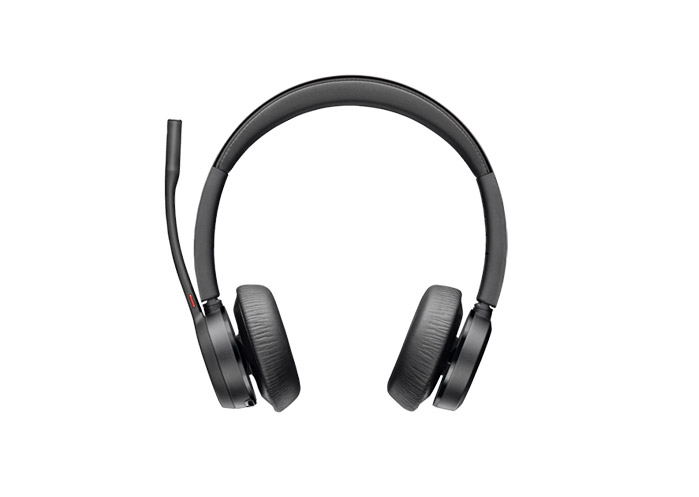
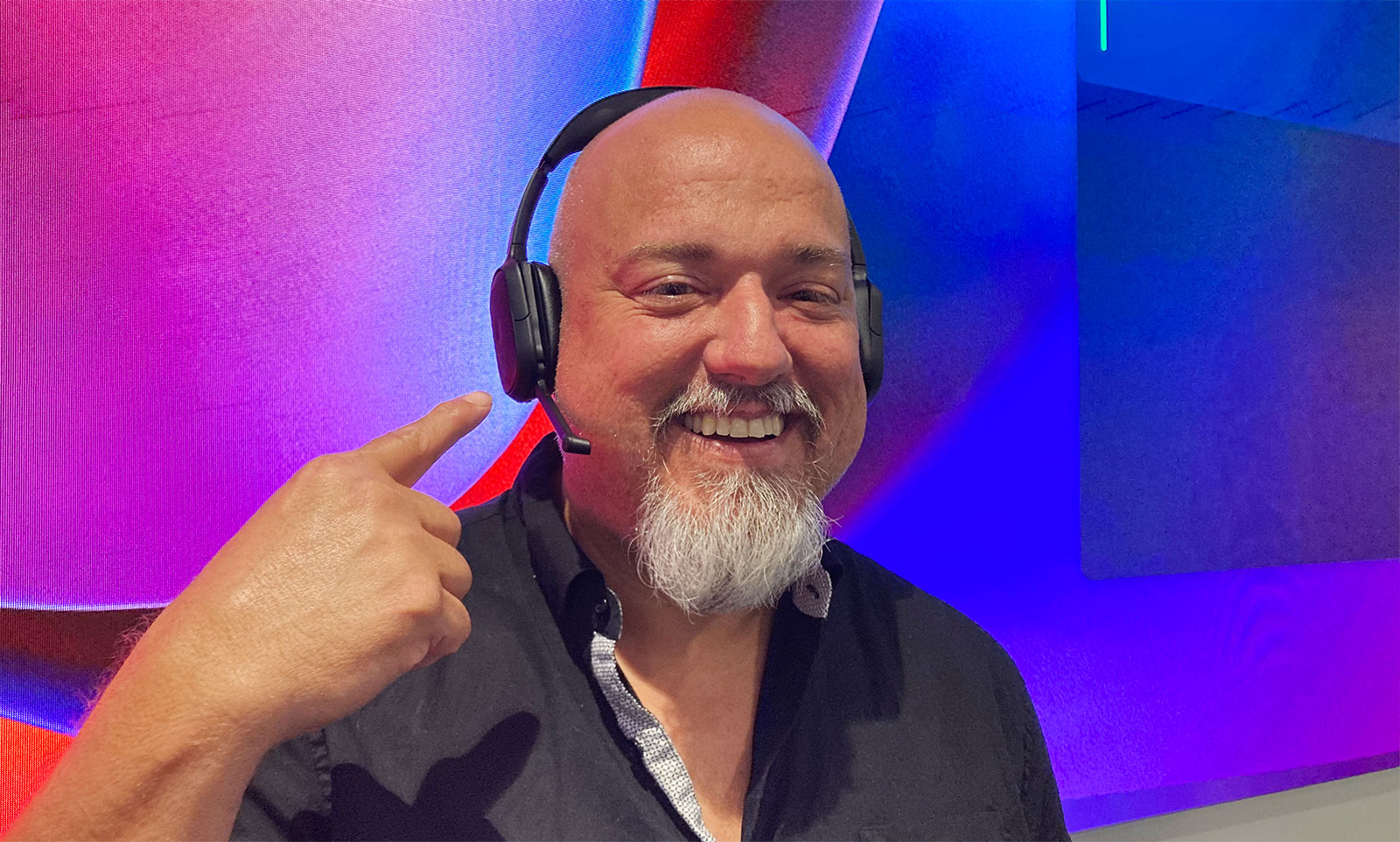
To be honest, when I decided to test the Poly Focus 625, I was somewhat skeptical. I generally prefer larger earcup designs and don’t usually expect smaller headsets to deliver strong passive noise isolation. After using it, I’m impressed. Comfort, wearability, and overall experience have exceeded my expectations and now I’m using it regularly.
But First, the HP Poly Focus Specs
Reviews are more useful when you know the underlying assumptions. Here’s what HP Poly publishes for the Focus 625 (the standard, non-folding model I’ve been wearing):
Specifications
HP Poly Focus 625
Connectivity
Bluetooth 5.4, audio over USB-C, BT700 adapter in the box
Microphones
6 total, 4 for transmit noise reduction, 2 for ANC
Noise handling
Acoustic Fence 2.0 with enhanced noise reduction + Hybrid ANC
Speakers
32 mm drivers, spatial audio
Weight
208 g (0.46 lb)
Talk time
Up to 25 hours with ANC and busy light on; up to 30 hours with both off
Charge time
Under 2.5 hours over USB-C
Serviceable parts
Replaceable battery, magnetic replaceable ear cushions
Certifications
Microsoft Teams (including Open Office), Zoom, Google Meet, TCO 10
Notable extras
Hideaway boom, busy light, tactile jog wheel, smart sensors
HP Poly Focus 625 specs, per HP Poly’s published product brief.
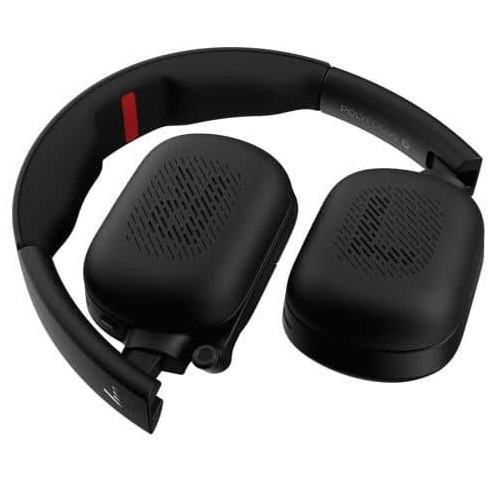
The Focus 620 shares the same platform, and both come in a Fold version that adds a folding hinge and a hard travel case instead of a soft pouch. Optional over-the-ear cushions are sold separately if you want a deeper seal.
Here’s how my real-world Focus 625 experience stacked up against the specs.
1. Passive noise cancellation that earns its keep
This is the one I was ready to be disappointed by. My experience is the reason I’m writing this review.
Full disclosure: in our office, I am the noise. I have a voice that carries, and I’ve made more inadvertent guest appearances on other people’s client calls than I care to admit. So I tested this one in reverse.
I handed the Focus 625 to a colleague, put them on a recorded call, and then stood a few feet behind them doing what I do e.g. talking with a co-worker at full volume. I even cut loose with a loud laugh or two.
Then I went back and listened to the recording. I was barely there. Even the laughing, which is the hardest thing to suppress, was hardly audible. The person on the other end probably never knew I was there.
That’s Acoustic Fence 2.0. Four of the six mics are dedicated to figuring out what’s the wearer’s voice and what’s the room, and the far end only gets the first part. Hybrid ANC handles the ambient noise for the wearer, so they aren’t fighting the room either.
If you work in an open-plan office, a cube farm, or a home office with a dog in it, this is the HP Poly Focus feature I’d put first.
2. Comfort I stopped thinking about
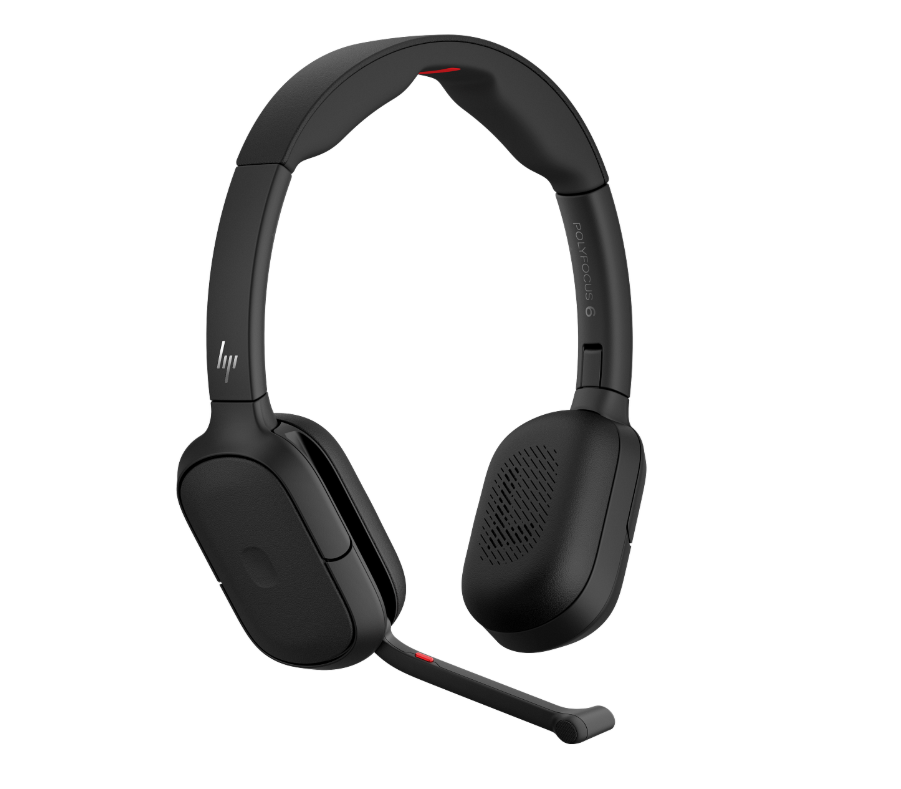
208 grams doesn’t seem like a meaningful number until you’ve worn something heavier through a day of back-to-back calls. The Focus 6’s ergonomic headband spreads pressure instead of concentrating it on one spot, and the cushions are soft enough that my glasses aren’t fighting the clamp force.
I think the most telling indicator of headset comfort isn’t whether you think it feels good after your first call. It’s whether you take it off between calls. I stopped taking it off.
3. Battery life that outlasted my patience
HP Poly rates the Focus 6 Series at up to 25 hours of talk time with ANC and the online busy light turned on, and up to 30 hours with both turned off.
I set out to drain it and, candidly, I gave up before it did. I never got through a full talk-time test. I did leave it powered on and connected for 26 hours straight and at the end of that it still showed roughly 50% remaining. That’s not the same as 26 hours of continuous conversation, I know, but it tells you the what’s important: this is a charge-it-when-you-think-about-it headset, not a plug-it-in-at-lunch headset.
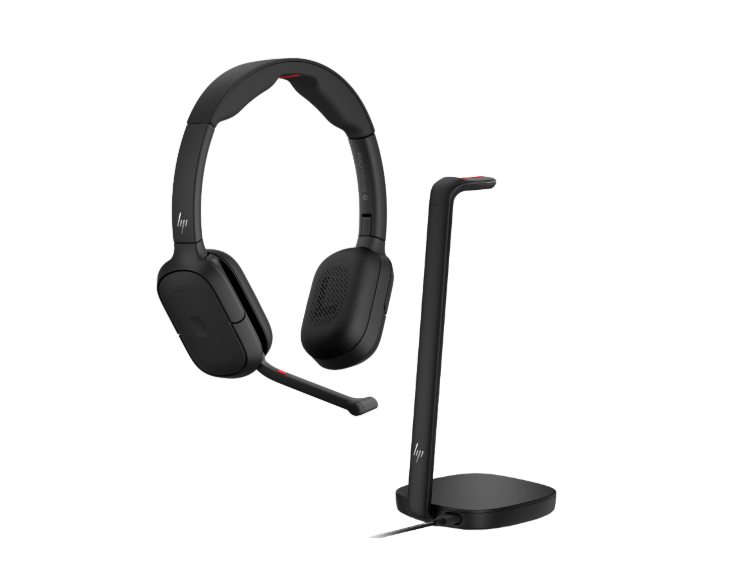
Charge time is under two and a half hours over USB-C. Add the wireless charge stand and you can just set it down at the end of the day.
4. Built to be repaired, not replaced
This is the big one if you’re managing headsets for a department, a call center, or a whole business.
More often than not, people replace their headsets because they’re worn out, not because they’re obsolete. The parts that wear out first on any headset are the ear cushions and the battery. On the Focus 6, both are replaceable. Obviously, I didn’t need any replacements yet, but I did try removing the ear cushions to see if replacing them was realistic. They’re actually magnetic, so you just pull the old one off and slip a new one on. There’s no moment where you think you’re about rip the new cushion or break a plastic tab and turn a $30 fix into a $300 problem.
It doesn’t take a finance degree to know that a headset that gets a fresh set of cushions in year two and a fresh battery every 3-5 years has a very different total cost of ownership than one you throw away and re-buy. That’s why the Focus carries TCO 10 certification, an independently verified sustainability credential.
5. The hideaway boom, the feature I didn’t know I wanted
Think about the last video call you sat through. Somebody had a boom arm cutting across their face, and their virtual background was trying to erase it in real time, taking part of their jaw along with it.
HP Poly designed the Focus 6 boom to tuck flush against the headset so there are no see-through gaps around it, because those gaps are exactly what a virtual background can’t resolve. HP Poly has said they actually made a priority of ensuring the headset read well on camera first.
I put it to the test and grabbed screenshots from three angles. No ghosting, no chewed-up jawline. The only gap I could find at all was under the headband and over my ears, and it never produced a visible edge. See for yourself!
Another bonus, the boom mutes with a simple flip up. When someone walks up to my desk mid-call or I need to clear my throat, a flick of the finger is all it takes. No hunting for a mute button, no shuffling windows across three monitors to find the right control.
So, do I recommend it?
If you spend your days in an open office, travel often, or spend most of your day on camera, the Focus 6 is an easy recommendation. Go with the Fold version with the hard case if you’re on planes regularly. Add the over-the-ear cushions if you want maximum isolation for focus work.
If you sit in an office with a closed door and make an occasional video meeting appearance, you may not notice or need everything this headset can do, although you’ll still notice the comfort.
Bottom line
I came into this HP Poly Focus review as a skeptic with a lot of options and a strong preference for a different style, and it’s now in my regular rotation. That’s about the highest compliment I know how to give a headset.
If you want to try one before you commit, or you’re sizing a rollout and want to talk through models and total cost across a fleet, reach out to our team at UnifiedCommunications. We’ll get one in your hands.